
AI Should Create Measurable Business ValueNot Just Excitement
The pressure to move quickly on AI is real. So is the risk of investing without a clear path to business value.
STG helps you cut through the hype, identify practical opportunities, and align AI investments with measurable business outcomes.
The Problem
AI Isn't Failing. Poor Alignment Is.
Organizations aren't struggling because AI lacks potential.
They're struggling because too many AI initiatives begin with the technology instead of the business problem.
Leaders often ask:
“How can we use AI?”
The better question is:
“What business challenge are we trying to solve?”

Without a clear answer, AI becomes another disconnected technology investment - one that generates excitement but delivers little measurable value.
The organizations seeing meaningful results aren't necessarily using more AI.
They're using AI with greater intention.
What Misalignment Looks Like
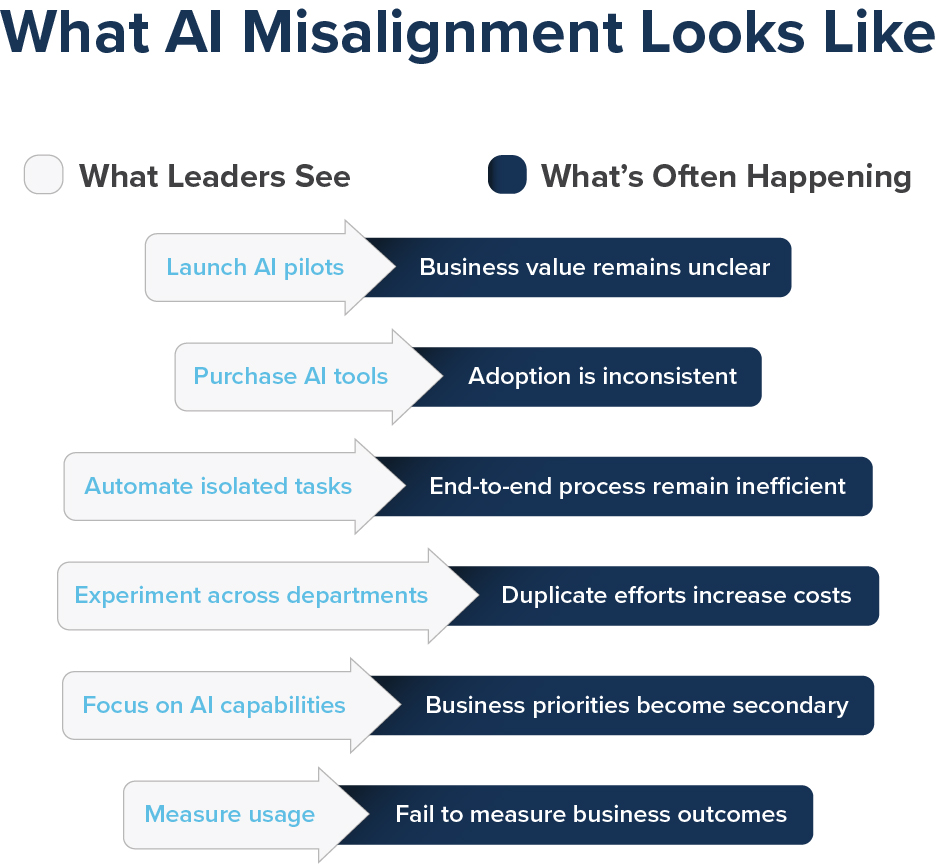
- What Organizations Do: Launch AI pilots
- What Often Happens: Business value remains unclear
- What Organizations Do: Purchase AI tools
- What Often Happens: Adoption is inconsistent
- What Organizations Do: Automate isolated tasks
- What Often Happens: End-to-end processes remain inefficient
- What Organizations Do: Experiment across departments
- What Often Happens: Duplicate efforts increase costs
- What Organizations Do: Focus on AI capabilities
- What Often Happens: Business priorities become secondary
- What Organizations Do: Measure usage
- What Often Happens: Fail to measure business outcomes
The question isn't whether AI works.
The question is whether it's solving the right problems.
Why AI Initiatives Stall
It's Rarely the Technology
AI projects rarely fail because of the technology itself.
More often, they lose momentum because organizations haven't created the conditions for success.
Unclear business objectives.
AI is introduced without a clearly defined problem to solve.
Poor data quality.
AI can only produce reliable insights when the underlying data is accurate, complete, and well-governed.
Lack of executive alignment.
Different leaders have different expectations for what AI should accomplish.
Unrealistic expectations.
Organizations expect transformational results before establishing foundational capabilities.
No plan for adoption.
Employees aren't prepared to integrate AI into daily workflows.
Success isn't measured.
Usage is tracked. Business impact isn't.
Leadership Questions
Are You Ready to Invest in AI?
Before investing in AI, ask:
- What business problem are we trying to solve?
- How will AI improve customer experience, productivity, or decision-making?
- Do we have the data required to support reliable AI outcomes?
- How will we measure success?
- What risks should we address before implementation?
- Which processes should not be automated?
- What governance policies are in place?
- Are employees prepared to work alongside AI?

Self Assessment
AI Readiness Scorecard
Rate each statement from 1-5.
- We have clearly identified business problems AI could help solve.
- Leadership agrees on AI priorities.
- Our data is accurate and well-governed.
- We have measurable success metrics.
- Employees understand how AI will support their work.
- Governance policies are defined.
- AI initiatives align with business strategy.
- We regularly evaluate AI outcomes.
- Executive sponsors are actively engaged.
- AI investments are prioritized based on business value.
0 of 10 rated
Rate the statements above to see where your organization stands.
Executive Toolkit
AI Strategy Executive Toolkit
Artificial intelligence should help organizations make better decisions, improve efficiency, and create new opportunities - not add unnecessary complexity.
We've created this toolkit to help business and technology leaders evaluate AI opportunities, align investments with business priorities, and lead more productive conversations about responsible AI adoption.
AI Opportunity Assessment Checklist
Evaluate whether your organization is ready to invest in AI and identify the areas where it can create the greatest business value.
You'll assess:
- Business readiness
- Data quality
- Governance
- Executive alignment
- Technology readiness
- Risk
- Success measurement
Executive AI Discussion Guide
Lead more strategic conversations about AI with your leadership team.
Topics include:
- Identifying high-value use cases
- Evaluating business impact
- Managing risk
- Preparing employees
- Measuring ROI
- Building governance
Executive White Paper
“Beyond the Hype: Building an AI Strategy That Delivers Business Value” - why organizations struggle to realize value from AI, and a practical framework for identifying the right opportunities, aligning leadership, and measuring success.
Inside you'll learn:
- Why many AI initiatives fail to deliver ROI
- How to identify meaningful AI use cases
- The importance of data, governance, and executive alignment
- A framework for evaluating AI investments
- How to measure business outcomes - not just AI adoption
How STG Helps
Artificial Intelligence Is Not a Strategy. It's a Capability.
The organizations achieving the greatest value from AI begin with clear business objectives, align stakeholders around measurable outcomes, and build the governance needed to scale responsibly.
STG helps organizations:
- Identify high-impact AI opportunities
- Align AI initiatives with business strategy
- Assess data readiness and governance
- Prioritize investments based on business value
- Reduce implementation risk
- Measure outcomes and continuously improve

We don't start with AI.
We start with the business challenges you're trying to solve.
Don't Chase AI.Put It to Work.
The organizations gaining the greatest advantage from AI aren't necessarily using more of it - they're using it with greater purpose.
If you're exploring AI, evaluating investments, or trying to determine where it can create the greatest value, we'll help you build a practical roadmap that aligns innovation with business outcomes.