
Your Legacy Systems Shouldn't BeHolding Back Your Business
Legacy systems can become expensive to maintain, difficult to change, and a barrier to what the business needs next.
Modernization doesn't mean replacing everything. STG helps you identify what needs to change, prioritize the investments that matter most, and build a practical roadmap that reduces risk and supports growth.
The Problem
Legacy Systems Rarely Break. They Slowly Hold the Business Back.
Most legacy systems continue to function for years - even decades.
The issue isn't that they stop working. It's that they become progressively more difficult to change.
- What once supported growth now creates delays.
- Routine updates require extensive effort.
- Integrations become increasingly complex.
- Maintenance consumes resources that could be invested in innovation.
The signs are often subtle at first, but over time they become part of the organization's daily experience.
- Projects take longer.
- Teams rely on manual workarounds.
- Technical debt accumulates.
- Innovation slows.

The greatest cost isn't keeping legacy systems running.
It's the opportunities your organization never pursues because change has become too difficult.
What Misalignment Looks Like
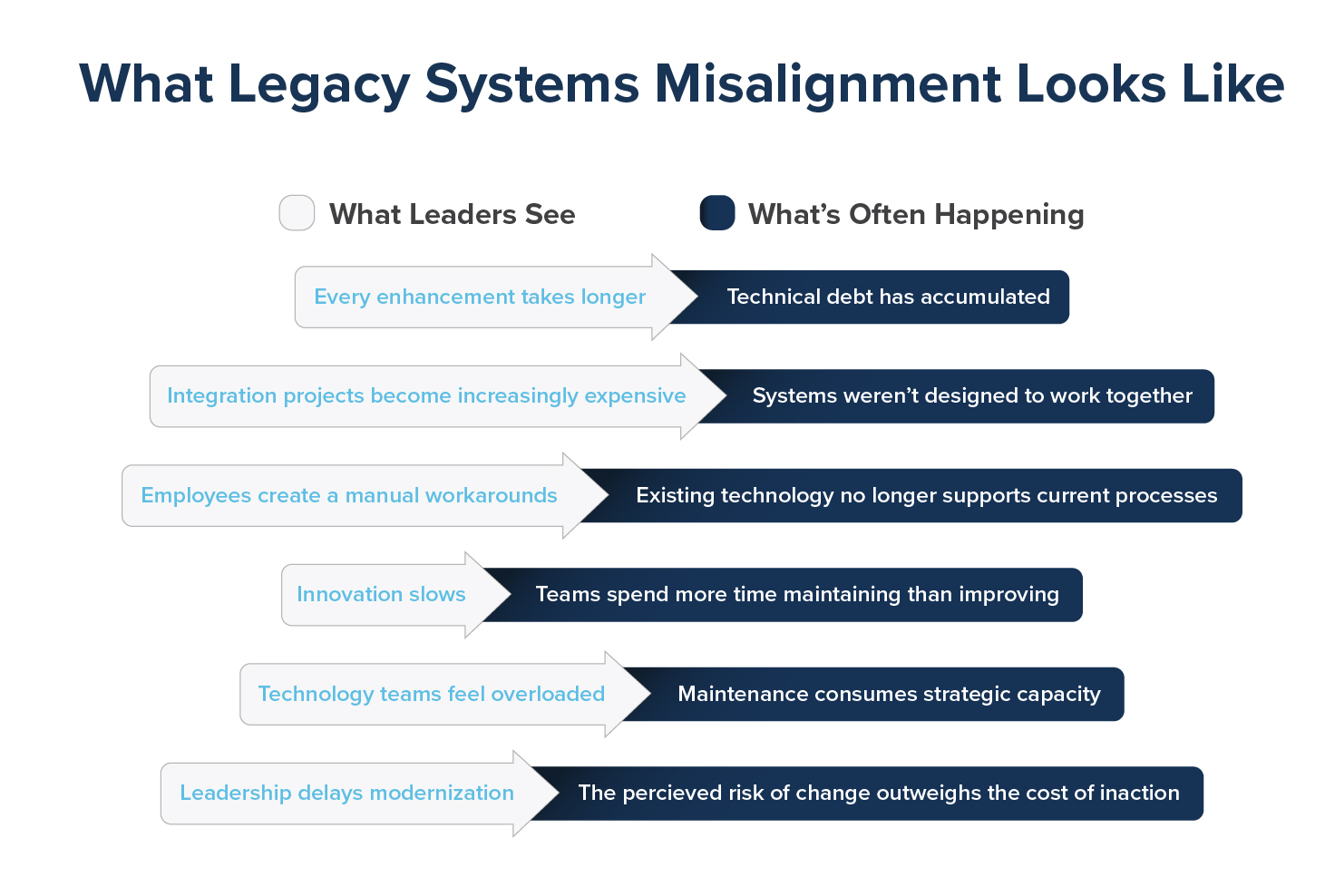
- What Leaders Experience: Every enhancement takes longer
- What's Often Happening: Technical debt has accumulated
- What Leaders Experience: Integration projects become increasingly expensive
- What's Often Happening: Systems weren't designed to work together
- What Leaders Experience: Employees create manual workarounds
- What's Often Happening: Existing technology no longer supports current processes
- What Leaders Experience: Innovation slows
- What's Often Happening: Teams spend more time maintaining than improving
- What Leaders Experience: Technology teams feel overloaded
- What's Often Happening: Maintenance consumes strategic capacity
- What Leaders Experience: Leadership delays modernization
- What's Often Happening: The perceived risk of change outweighs the cost of inaction
Legacy systems don't just affect IT.
They affect every part of the business that depends on technology to operate efficiently.
Why Modernization Feels So Difficult
It's Not the Need That's Unclear. It's the Path.
Organizations rarely delay modernization because they don't recognize the need.
They delay because the path forward feels uncertain.
Business disruption feels risky.
Leaders worry about interrupting operations or impacting customers.
The scope seems overwhelming.
Modernization is often viewed as a single, all-or-nothing initiative instead of a series of manageable improvements.
Dependencies are unclear.
Over time, systems become tightly connected, making it difficult to predict the impact of changes.
Priorities compete.
Immediate business needs often take precedence over long-term technology improvements.
Technical debt isn't visible.
The true cost of aging systems is difficult to quantify until it begins affecting delivery, customer experience, or operational performance.
There isn't a clear roadmap.
Organizations know they need to modernize but struggle to determine where to begin.
Leadership Questions
Where Is Aging Technology Costing You Most?
Before investing in modernization, ask:
- Which systems create the greatest operational friction?
- Which applications are most difficult or expensive to maintain?
- Where do manual workarounds consume employee time?
- Which systems present the greatest business risk?
- If one critical application failed tomorrow, what would the business impact be?
- Which modernization efforts would produce the greatest business value?
- Are we delaying change because of cost - or because of uncertainty?
- Do we have a roadmap that balances business priorities with technology improvements?

Self Assessment
Legacy Systems Modernization Scorecard
Rate each statement from 1-5.
- We understand which systems create the greatest operational risk.
- Technical debt is regularly evaluated.
- We have a documented modernization roadmap.
- Leadership agrees on modernization priorities.
- Business and IT collaborate on modernization decisions.
- Manual workarounds are actively identified and reduced.
- System integrations support current business needs.
- Modernization efforts are prioritized by business value.
- We regularly review the total cost of maintaining legacy systems.
- Our technology supports future growth.
0 of 10 rated
Rate the statements above to see where your organization stands.
Executive Toolkit
Legacy Systems Modernization Executive Toolkit
Modernization isn't about replacing everything. It's about making better decisions about where to invest, what to improve, and how to reduce risk without disrupting the business.
We've created this toolkit to help business and technology leaders evaluate legacy systems, identify modernization priorities, and facilitate productive conversations across leadership teams.
Legacy Systems Assessment Checklist
Evaluate the health of your current technology environment and identify where legacy systems are creating unnecessary risk, cost, and operational complexity.
You'll assess:
- Business impact
- Technical debt
- Operational risk
- Maintainability
- Integration complexity
- Security
- Modernization readiness
Executive Modernization Discussion Guide
Lead strategic conversations about legacy systems with business and technology leaders.
Topics include:
- Prioritization
- Business risk
- Modernization planning
- Investment decisions
- Change management
- Long-term technology strategy
Executive White Paper
“Modernizing Without Disrupting the Business: A Practical Guide to Legacy Systems” - why modernization efforts stall, how technical debt affects performance, and a framework for prioritizing improvements without unnecessary risk.
Inside you'll learn:
- The hidden cost of technical debt
- How legacy systems slow growth
- Why modernization efforts often stall
- A business-first framework for modernization
- How to build an achievable modernization roadmap
How STG Helps
Modernization Should Reduce Complexity - Not Create More of It
STG helps organizations:
- Assess the business impact of legacy systems
- Prioritize modernization efforts based on strategic value
- Build practical modernization roadmaps
- Reduce technical debt and operational risk
- Improve integration and scalability
- Align technology investments with long-term business goals

We don't believe every legacy system needs to be replaced. We believe every technology decision should support the business.
Sometimes that means modernizing. Sometimes it means optimizing. Sometimes it means leaving a system in place and investing elsewhere.
Our role is to help you make those decisions with clarity and confidence.
Modernize with Purpose - Not Pressure
Legacy systems don't become business problems overnight, and modernization doesn't need to happen all at once.
The key is understanding where aging technology is creating the greatest friction, risk, and cost - and taking the right next step.
Whether you're evaluating a single application or planning a long-term modernization strategy, we'll help you build a roadmap that aligns technology investments with business priorities.