
Your Technology Projects Should Deliver Business ResultsNot Just Meet Deadlines
A project can finish on time and on budget and still fail to deliver the business value you expected.
STG helps you align technology initiatives with strategic priorities, improve execution, and turn completed projects into measurable business results.
The Problem
Technology Projects Don't Fail Only When They Miss Deadlines
When people think about project failure, they often imagine missed deadlines, budget overruns, or canceled initiatives.
But many technology projects technically succeed.
- They launch.
- They stay on schedule.
- They meet scope.
And yet...
- The business sees little improvement.
- Customer experience doesn't change.
- Teams continue using manual workarounds.
- Executives question whether the investment was worthwhile.

The problem wasn't execution.
The problem was that the project was never fully connected to the business outcome it was meant to achieve.
Technology projects shouldn't be judged solely by what they deliver. They should be judged by what they make possible.
What Misalignment Looks Like
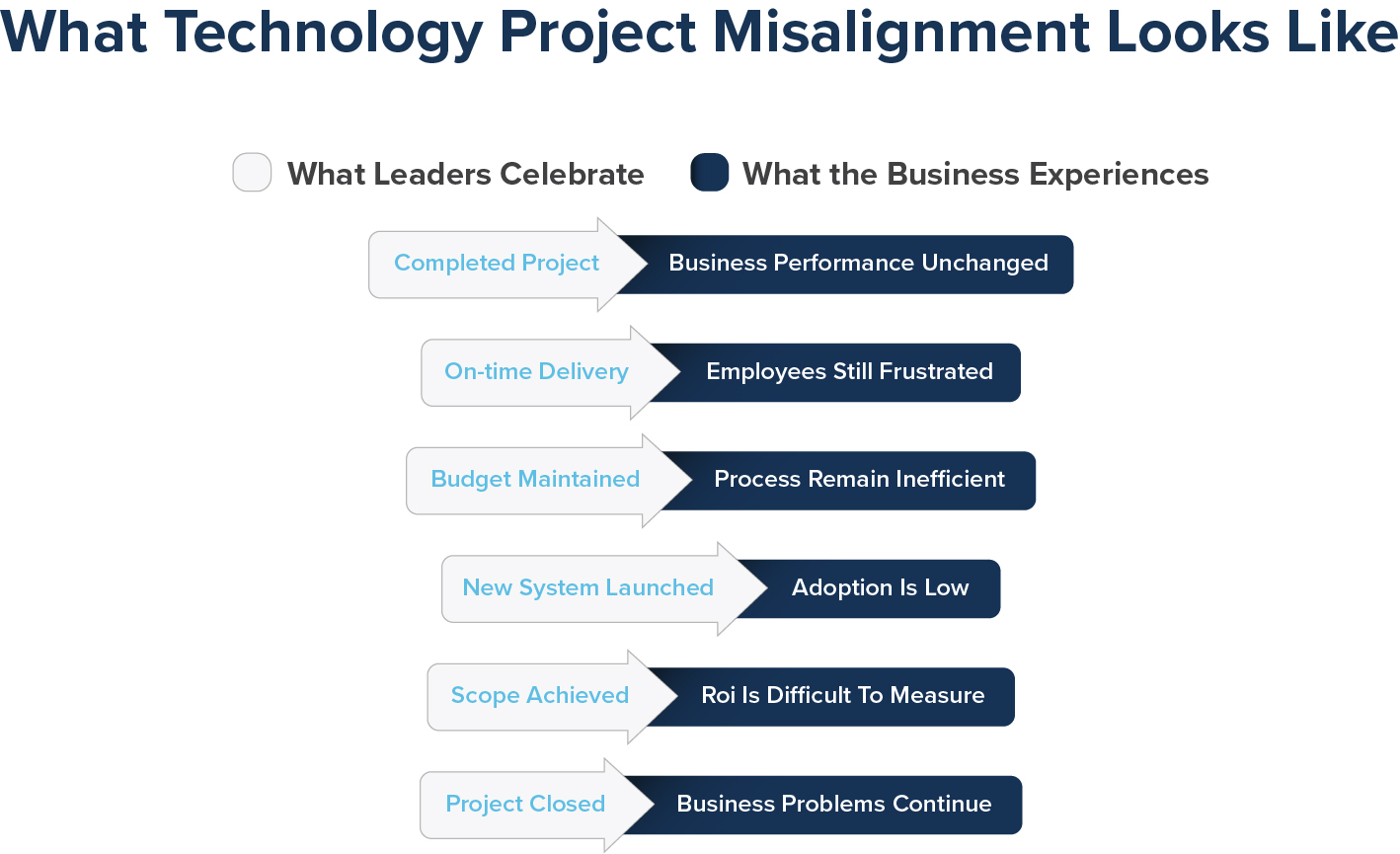
- What Leaders Celebrate: Project completed
- What the Business Experiences: Business performance unchanged
- What Leaders Celebrate: On-time delivery
- What the Business Experiences: Employees still frustrated
- What Leaders Celebrate: Budget maintained
- What the Business Experiences: Processes remain inefficient
- What Leaders Celebrate: New system launched
- What the Business Experiences: Adoption is low
- What Leaders Celebrate: Scope achieved
- What the Business Experiences: ROI is difficult to measure
- What Leaders Celebrate: Project closed
- What the Business Experiences: Business problems continue
This doesn't mean the project team failed.
It often means success was defined too narrowly from the beginning.
Why Projects Miss Business Outcomes
The Causes Usually Sit Outside the Project Plan
Most organizations don't lack capable project managers or talented teams.
Instead, projects lose momentum because of issues outside the project plan.
Business goals aren't clearly defined.
Teams know what they're building but not why it matters.
Priorities change during execution.
Business needs evolve, but project objectives don't.
Executive alignment weakens.
Different stakeholders expect different outcomes.
Success metrics focus on delivery.
Milestones are tracked. Business impact isn't.
Change management is overlooked.
The technology works. People don't adopt it.
Teams work in silos.
Business, technology, and operations move in parallel instead of together.
Leadership Questions
Did the Project Actually Change Anything?
Before declaring a project successful, ask:
- What business problem was this project intended to solve?
- Have we measured whether that problem actually improved?
- Can we demonstrate business value - not just project completion?
- Are employees using the new solution as intended?
- Has customer experience measurably improved?
- Have we reduced costs, increased productivity, or lowered risk?
- Would we invest in this project again knowing what we know today?
- What lessons should influence future initiatives?

Self Assessment
Technology Project Success Scorecard
Rate each statement from 1-5.
- Every project has a clearly defined business objective.
- Executive sponsors remain engaged throughout delivery.
- Success metrics focus on business outcomes.
- Stakeholders agree on project priorities.
- Teams understand how their work supports company goals.
- User adoption is measured after launch.
- Business value is reviewed after implementation.
- Lessons learned influence future projects.
- Projects are prioritized based on strategic impact.
- Leadership has visibility into project performance.
0 of 10 rated
Rate the statements above to see where your organization stands.
Executive Toolkit
Technology Project Executive Toolkit
Technology projects succeed when teams have clarity - not just a plan.
We've created this toolkit to help business and technology leaders improve project alignment, strengthen decision-making, and increase the likelihood that technology initiatives deliver lasting business value.
Technology Project Success Checklist
Ensure every technology initiative begins with the right foundation.
You'll evaluate:
- Strategic alignment
- Executive sponsorship
- Business objectives
- Risk management
- Stakeholder alignment
- Adoption planning
- Outcome measurement
Executive Project Discussion Guide
Lead better conversations before, during, and after technology projects.
Topics include:
- Defining business outcomes
- Prioritizing initiatives
- Managing changing priorities
- Measuring success
- Executive accountability
Executive White Paper
“Why Successful Technology Projects Still Fail to Deliver Business Value” - why organizations keep completing projects that don't meaningfully improve business performance, and how leadership teams can redefine success before the next initiative begins.
Inside you'll learn:
- Why project success and business success are different
- Common causes of project misalignment
- How executive alignment influences delivery
- The importance of measuring outcomes after launch
- A practical framework for improving project performance
How STG Helps
Every Technology Project Begins With a Business Objective
We help organizations:
- Align projects with strategic priorities
- Improve executive visibility
- Strengthen stakeholder alignment
- Reduce delivery risk
- Increase user adoption
- Measure business outcomes after implementation
- Build confidence in future technology investments

Because the most successful technology projects don't simply deliver software.
They deliver measurable business results.
Complete Projects.Deliver Results.
Technology projects should create measurable business impact - not just another completed milestone.
Whether you're preparing to launch a new initiative, recovering a struggling project, or improving your project portfolio, we'll help you align execution with business strategy.