STG

Start typing to search across every section of the site.

Loading…
Blog

Technology Strategy Consulting: What It Fixes, What It Costs, and When You Need It

October 30, 202612 min read
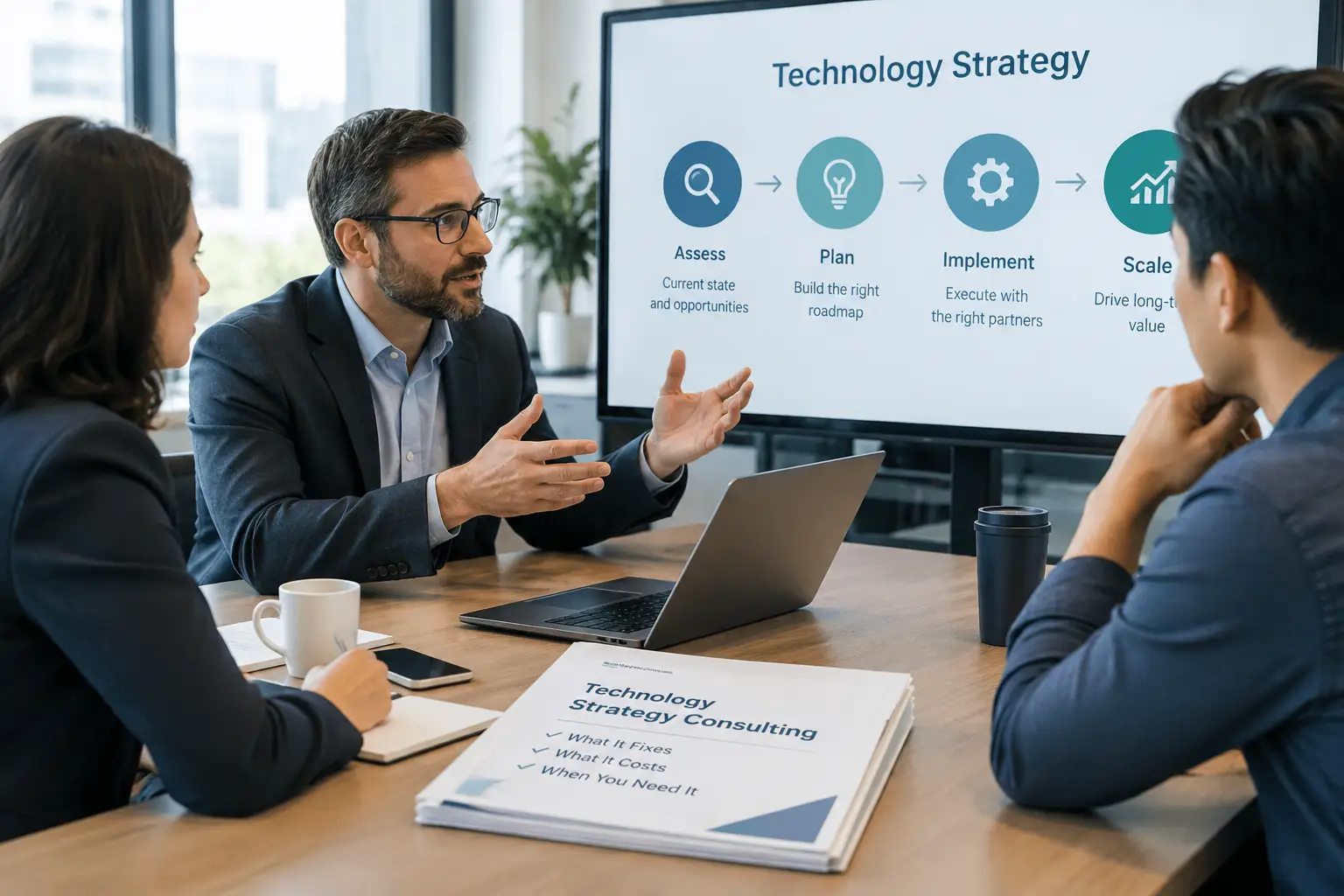
Technology Strategy Team Meeting

How much of your technology budget is driving growth?

When technology investments are not clearly connected to business priorities, leaders face a difficult question: which investments are helping the business move forward, and which are adding cost, complexity, or risk?

Technology strategy consulting helps answer that question. It provides an outside perspective on how technology supports business objectives and helps leadership determine what to fund, improve, consolidate, or stop.

The goal is not simply to create another technology roadmap. It is to give business leaders the clarity and alignment needed to make better investment decisions and move important initiatives forward.

This guide explains what technology strategy consulting involves, when it makes sense, what an engagement should deliver, and how to evaluate its business value.

What Is Technology Strategy Consulting?

Technology strategy consulting helps organizations align technology decisions with business goals. It examines how existing systems, investments, teams, and capabilities affect growth, operating costs, and business risk, then develops recommendations that leadership can prioritize and act on.

Unlike day-to-day IT support, technology strategy consulting focuses on decisions about the organization’s future.

It helps answer questions such as:

  • Which technology investments are essential to achieving our business goals?
  • Where are we spending money without receiving sufficient value?
  • Which systems or processes are limiting our ability to grow?
  • What risks are we accepting by maintaining our current approach?
  • What should we prioritize, and what can wait?
  • How do we ensure future technology decisions remain aligned with business priorities?

A useful strategy should provide more than a list of projects. It should establish a clear connection between business objectives, technology priorities, investment decisions, and measurable outcomes.

Why Technology and Business Strategy Become Misaligned

Technology and business priorities can drift apart when investment decisions are made independently, business needs change, or leadership lacks a shared view of how technology supports organizational goals.

This misalignment rarely happens because of one bad decision.

More often, it develops gradually as teams respond to immediate needs without regularly evaluating the broader business impact.

Several patterns contribute to the problem.

Technology budgets follow historical spending

Existing contracts, licensing commitments, and maintenance requirements can become the starting point for each new budget cycle.

Without reviewing how those investments support current business priorities, organizations may continue funding technology that no longer delivers sufficient value.

Projects are evaluated independently

An individual technology initiative may appear justified on its own.

But when projects are approved without considering the broader strategy, organizations can accumulate overlapping systems, competing priorities, and unnecessary complexity.

Business and technology leaders are not aligned

Business leaders often focus on growth, profitability, operational performance, and risk.

Technology teams may focus on reliability, system requirements, technical dependencies, and delivery commitments.

Both perspectives are necessary. Problems arise when there is no consistent process for connecting them.

Legacy systems consume resources

Older systems may remain essential to daily operations, even when they are expensive to maintain or difficult to adapt.

The challenge is determining when to maintain, improve, modernize, or replace them based on business value rather than technology age alone.

Emerging technology investments lack clear objectives

AI and other emerging technologies can create meaningful opportunities, but experimentation without defined business outcomes can lead to disconnected initiatives.

Before investing, leadership should understand what problem the technology is expected to solve, how success will be measured, and what organizational changes may be required.

These issues are not necessarily signs of poor technology management.

They are often signs that business and technology decisions need stronger alignment.

What Does Technology Misalignment Cost a Business?

Technology misalignment can affect a business in three important ways: missed growth opportunities, unnecessary operating costs, and increased risk.

The consequences may not appear immediately. They often emerge through slower execution, recurring expenses, operational limitations, and decisions that become more difficult to reverse.

1. Growth opportunities are delayed or missed

When technology cannot support changing business requirements, organizations may struggle to introduce new products, expand operations, improve customer experiences, or respond to market opportunities.

The business may have a clear growth strategy but lack the technology capabilities needed to execute it.

2. Operating costs increase without corresponding value

Disconnected systems, overlapping software, inefficient processes, and underused technology investments can increase costs without improving business performance.

The problem is not always the amount being spent.

It is whether the spending produces outcomes that justify the investment.

3. Business risk becomes harder to manage

Technology decisions can introduce operational, financial, security, and compliance risks.

When systems and investments are evaluated independently, leadership may lack a complete view of how those risks affect the organization.

The cost of waiting

Without a clear technology strategy, organizations may continue renewing unnecessary services, funding competing initiatives, or postponing decisions about systems that limit performance.

Over time, those choices can reduce flexibility and make future changes more expensive.

The longer an organization operates without a shared understanding of its technology priorities, the harder it may become to redirect resources toward the outcomes that matter most.

The objective of technology strategy consulting is to make these tradeoffs visible before they become more costly.

When Does a Business Need Technology Strategy Consulting?

A business should consider technology strategy consulting when important business outcomes depend on technology decisions and leadership needs greater clarity, alignment, or specialized perspective to move forward.

The need is not determined by company size or whether the organization has a CIO or CTO.

It is determined by the importance of the business decision and the organization’s ability to evaluate and execute it.

Common indicators include:

  1. Technology spending is increasing without clear business value. Leadership cannot confidently explain how investments contribute to growth, efficiency, or risk reduction.
  2. Major initiatives compete for resources. Multiple projects appear important, but there is no consistent framework for deciding which should take priority.
  3. Technology is slowing business execution. Existing systems, processes, or organizational capabilities limit the ability to pursue strategic opportunities.
  4. Cloud or software costs are difficult to control. Spending continues to grow without clear accountability or sufficient visibility into its business value.
  5. AI initiatives lack defined outcomes. Teams are experimenting with new capabilities without agreement on where they can create measurable business value.
  6. A major business change is approaching. Expansion, acquisition, restructuring, or a significant operational initiative requires important technology decisions.
  7. Leadership lacks a shared technology direction. Business and technology teams have different assumptions about priorities, investments, or responsibilities.
  8. Delivery challenges continue despite additional resources. Adding people, vendors, or technology has not resolved underlying execution problems.

Any one of these situations may justify an outside assessment if the potential business impact is significant.

The question is not how many warning signs exist. It is whether the organization has enough clarity to make the right decision.

What Does a Technology Strategy Consultant Actually Do?

A technology strategy consultant helps leadership evaluate the current situation, identify the decisions that matter most, and establish a practical path from business priorities to technology action.

The work typically combines business analysis, technology assessment, investment prioritization, and executive alignment.

A well-scoped engagement may include five stages.

1. Understand the business objectives

The consultant begins by identifying what the organization is trying to accomplish.

That may include improving profitability, supporting growth, increasing operational capacity, reducing risk, or preparing for a major business change.

The objective is to define success in business terms before evaluating technology options.

2. Evaluate the current technology environment

The next step is to understand how existing technology supports or limits those objectives.

Depending on scope, the assessment may consider:

  • Technology spending and contractual commitments
  • Core business systems and infrastructure
  • Business processes and operational dependencies
  • Internal technology capabilities and external partners
  • Data, security, and operational risks
  • Current projects and planned investments

The purpose is not to evaluate technology in isolation.

It is to understand how technology affects business performance.

3. Identify opportunities and risks

The consultant works with business and technology stakeholders to determine where changes could create value.

This may include reducing unnecessary spending, improving existing systems, addressing operational risks, or identifying capabilities required for future growth.

Recommendations should consider both potential benefits and the practical constraints involved.

4. Prioritize decisions and develop a roadmap

Not every opportunity should be pursued immediately.

A useful roadmap helps leadership understand what matters most, what depends on other work, what resources may be required, and how progress will be evaluated.

The roadmap should distinguish between immediate priorities, longer-term investments, and activities that may no longer be justified.

5. Establish accountability and measures of progress

A strategy becomes useful when leadership can act on it and determine whether the work is producing the intended results.

That requires clear ownership, decision-making responsibilities, and measures connected to business outcomes.

The exact deliverables should be established before the engagement begins.

Depending on scope, leadership may receive a current-state assessment, prioritized recommendations, investment analysis, a phased roadmap, and a proposed approach to governance and measurement.

The most important deliverable is not the document itself. It is the organization’s ability to make and execute better decisions.

Technology Strategy Consulting vs. IT Consulting vs. a Fractional CTO

Technology strategy consulting, IT consulting, and fractional CTO services can overlap, but they typically address different needs.

Technology strategy consulting focuses on aligning technology decisions with business direction. IT consulting is a broader category that may include strategic advice, specialized assessments, and implementation support. A fractional CTO provides ongoing senior technology leadership.

ConsiderationTechnology strategy consultingIT consultingFractional CTO
Primary focusAligning technology priorities with business goalsAddressing defined technology needs or challengesProviding ongoing technology leadership
Typical engagementAssessment, recommendations, and roadmapProject-based or advisory engagementPart-time leadership arrangement
Business needClarity around major investments and strategic prioritiesExpertise to evaluate or address a specific challengeContinuing executive oversight and direction
Typical deliverableStrategic recommendations and prioritized roadmapDefined advisory or delivery outcomesOngoing leadership, decisions, and accountability
Best fitLeaders facing significant technology decisionsOrganizations needing targeted expertise or execution supportOrganizations needing sustained senior technology leadership

These services are not mutually exclusive.

An organization may begin with a strategy engagement, execute the resulting priorities through internal or external teams, and use fractional leadership to maintain direction and accountability.

The appropriate model depends on the business challenge and the organization’s existing capabilities.

How Much Does Technology Strategy Consulting Cost?

Technology strategy consulting costs vary based on the scope of work, organizational complexity, level of expertise required, and expected deliverables.

A focused assessment of one business challenge may require significantly less work than an enterprise-wide strategy involving multiple systems, business units, and stakeholders.

Consulting engagements commonly use one of three pricing models.

Pricing modelHow it worksAppropriate use
Fixed-fee engagementA defined price for an agreed scope and set of deliverablesTechnology assessments, strategic planning, and roadmaps
Hourly or daily consultingFees based on time and expertiseTargeted advisory work or specialized reviews
Monthly retainerRecurring fee for an agreed level of supportOngoing strategic guidance or fractional leadership

Several factors influence the overall investment:

  • Scope: Whether the engagement addresses a specific decision, department, or the broader organization.
  • Complexity: The number of systems, business processes, stakeholders, vendors, and dependencies involved.
  • Depth: Whether leadership needs an initial assessment or detailed recommendations with implementation planning.
  • Deliverables: The level of financial analysis, roadmap development, and decision support required.
  • Ongoing involvement: Whether the engagement ends with recommendations or includes continued advisory support.

Published consulting-rate guides can provide a general benchmark, but they should not be treated as a substitute for a proposal based on the organization’s specific needs.

How should leadership evaluate the cost?

The more useful question is not simply what consulting costs.

It is what the organization stands to gain or avoid by making a better technology decision.

A strategy engagement may help leadership identify unnecessary spending, avoid a poorly justified investment, reduce business risk, or move a critical initiative forward.

Before committing, ask what decisions the engagement will support, what deliverables will be provided, and how those outputs will help the organization act.

The value should be evaluated against the business opportunity or risk at stake, not just the consultant’s hourly rate.

How to Choose a Technology Strategy Consulting Partner

The right technology strategy partner should help leadership understand the business problem before recommending technology or implementation work.

Technical experience is important, but the ability to connect that experience to business outcomes is what makes strategic advice valuable.

Consider these five questions.

1. Do they understand the business outcome we are trying to achieve?

A strong advisor should ask about growth objectives, operating performance, financial constraints, and risk before recommending a solution.

If the conversation begins and ends with technology capabilities, the engagement may not address the underlying business need.

2. Can they demonstrate relevant experience?

Ask for examples of comparable business challenges, the decisions the firm helped clarify, and the results achieved.

Relevant experience may come from a similar industry, technology environment, or strategic situation.

Where possible, request verified client examples or references.

3. How do they evaluate competing options?

A consultant should be able to explain the alternatives, tradeoffs, costs, and risks associated with its recommendations.

Ask whether the firm receives revenue from software products, implementation work, staffing, or other services it may recommend.

Transparency helps leadership assess the advice.

4. Can they help move the strategy into execution?

Some organizations need an independent assessment and can implement recommendations internally.

Others need additional delivery capabilities, leadership, or specialized expertise.

Determine how the consultant will support the transition from strategy to action and how responsibilities will be assigned.

5. How will we know the engagement was successful?

Success should be defined before work begins.

That may involve greater clarity around investment priorities, agreement on a roadmap, reduced exposure to a material risk, or progress toward a defined business outcome.

The measures should reflect the purpose of the engagement rather than simply the completion of consulting activities.

How STG Consulting Approaches Technology Strategy

STG Consulting is a business technology consulting firm that helps leaders understand how technology affects growth, cost, and risk.

Our work begins with clarity.

Before recommending new investments or changes, we help leadership understand where technology is supporting the business, where it may be creating unnecessary cost or risk, and which decisions deserve attention.

The STG Strategic Technology Framework® helps connect technology priorities with business objectives, creating a foundation for clearer decisions and stronger alignment.

From there, STG can bring the expertise needed to support progress, whether the organization requires strategic guidance, technology leadership, or help executing important initiatives.

The goal is not to create more technology activity.

Start with Clarity

If you are facing a significant technology decision but lack a clear connection between the investment and the business outcome, the next step is not necessarily another project.

It is understanding what matters most and where technology can make the greatest difference.

Get 30 minutes of executive perspective.

Talk with an STG advisor about the business priorities at stake, the technology decisions you are facing, and where greater clarity could help you move forward.

Frequently Asked Questions About Technology Strategy Consulting

What does a technology strategy consultant do?

A technology strategy consultant evaluates how an organization’s technology investments, systems, and capabilities support its business goals. The consultant identifies opportunities, risks, and competing priorities, then recommends actions that leadership can evaluate and execute. Deliverables may include an assessment, prioritized roadmap, investment recommendations, and measures of progress.

How long does a technology strategy engagement take?

The duration depends on the scope, complexity, number of stakeholders, and depth of analysis required. A focused assessment may take less time than a company-wide strategy involving multiple business units and technology environments. The timeline and expected deliverables should be agreed upon before work begins.

What is the difference between technology strategy and digital transformation?

Technology strategy establishes how technology should support business objectives and which investments deserve priority. Digital transformation generally refers to changes in business processes, operations, customer experiences, and organizational capabilities enabled by digital technologies. A clear strategy helps determine which changes are justified and how they should be prioritized.

Do mid-sized companies need technology strategy consulting?

A mid-sized organization may benefit from technology strategy consulting when important business outcomes depend on technology decisions and leadership needs additional perspective or expertise. The need is not determined by company size alone. What matters is the significance of the decision, the risks involved, and the organization’s ability to evaluate its options.

Is a fractional CTO better than a technology strategy consultant?

Neither is inherently better. A fractional CTO may be appropriate when an organization needs ongoing senior technology leadership. A technology strategy consultant may be appropriate when leadership needs a focused assessment, recommendations, or roadmap. Some organizations use both, depending on their capabilities and the work required.

See exactly where your technology stands

Five minutes today can reshape your next budget cycle. Get your technology score, benchmarked against what high-performing organizations actually do.

Share this article