The Growing Challenge of Legacy Systems
Many government organizations continue to rely on systems that have supported critical operations for years or even decades.
While these platforms often remain functional, they frequently introduce challenges such as:
- Increasing maintenance costs
- Limited integration capabilities
- Security vulnerabilities
- Data silos
- Reduced operational agility
- Difficulty adapting to evolving citizen and stakeholder expectations
Over time, these challenges create friction across departments and limit an agency’s ability to respond to changing needs.
The issue is rarely a lack of effort from internal teams.
More often, teams are spending significant time maintaining aging systems rather than focusing on innovation and mission advancement.
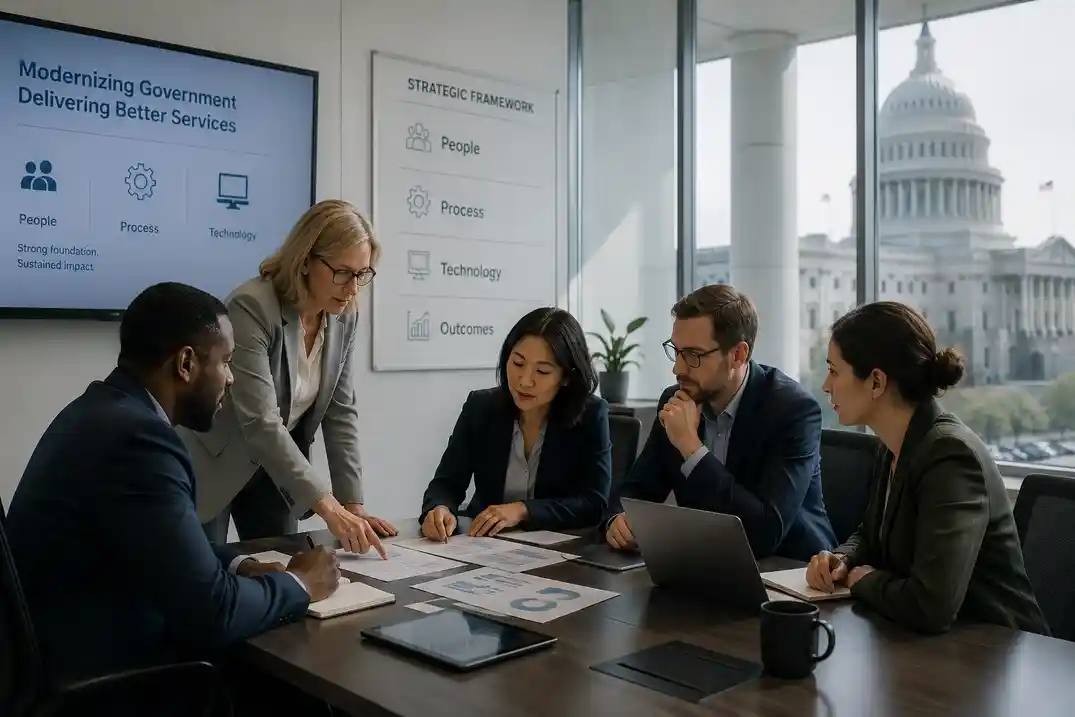
Modernization Requires More Than Technology
Technology is only one component of a successful modernization strategy.
Agencies that achieve meaningful results typically focus on several interconnected areas.
Leadership and Organizational Alignment
Successful transformation begins with a clear understanding of business objectives and mission priorities.
Technology investments should support agency goals, not operate independently from them.
When leadership, operations, and technology teams share a common vision, modernization efforts are significantly more likely to succeed.
Cloud and Infrastructure Modernization
Cloud technologies offer opportunities to improve scalability, reliability, resilience, and operational efficiency.
However, simply migrating workloads to the cloud does not automatically create value.
Organizations must ensure their cloud environments are secure, cost-effective, and aligned with long-term operational requirements.
Data as a Strategic Asset
Government agencies generate and manage enormous amounts of data.
Modernization efforts should focus on improving how data is collected, integrated, secured, and utilized to support decision-making.
Better data visibility often leads to better policy decisions, improved operational efficiency, and enhanced public services.
Security and Compliance
Modern threats require modern security strategies.
Agencies must continuously evaluate cybersecurity practices while ensuring compliance with evolving standards and frameworks.
Security can no longer be treated as a separate initiative.
It must be integrated into every stage of planning, development, deployment, and operations.
Process Optimization
Many modernization initiatives focus heavily on technology while overlooking business processes.
Automating inefficient processes simply allows organizations to perform inefficient work faster.
The most effective modernization efforts evaluate both technology and workflows to identify opportunities for meaningful improvement.