
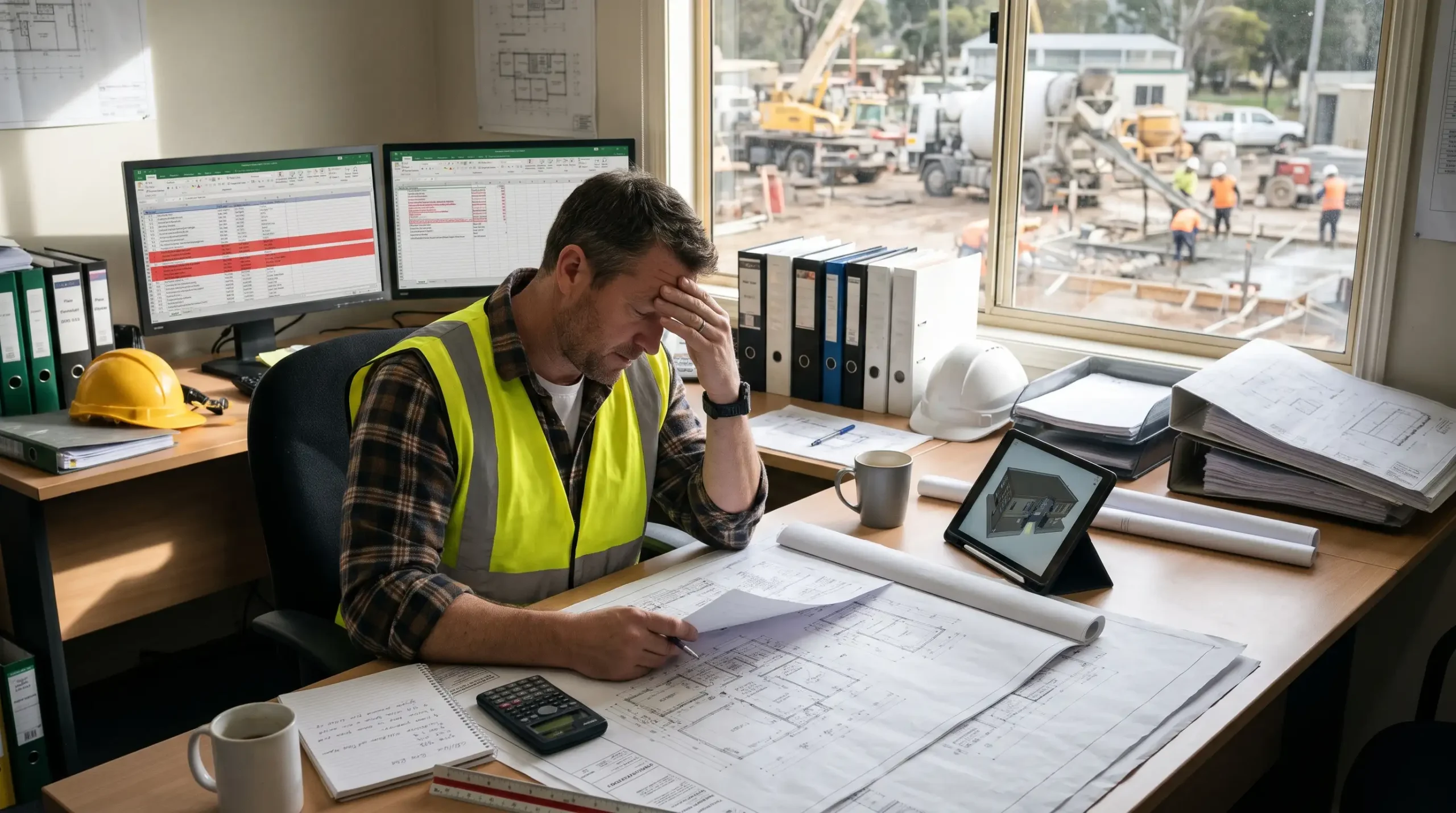
should be viewed as a margin-protection process, not simply an administrative estimating task.
The Real Risk Is the Gap Between Detection and Pricing
Construction teams often think about plan revisions in terms of document comparison.
What changed between the original drawing and the latest version?
That is an important question, but it is not enough.
A more useful question is: Which changes affect the work we are responsible for, and have those impacts been reflected in our pricing and project commitments?
A change to a drawing does not automatically mean a change in cost. Some revisions are clarifications. Others may affect constructability, quantities, material requirements, sequencing, or labor.
The estimator must distinguish between them.
That requires more than identifying differences between two documents. It requires connecting those differences to the contractor’s actual scope and cost structure.
A process that identifies a revised detail but fails to carry its implications into pricing still leaves the business exposed.
This distinction matters when contractors evaluate estimating technology. Faster drawing comparison is useful, but the greater business value comes from helping teams recognize and act on financially significant changes.
Why More Bidding Activity Can Increase Exposure
Many contractors face pressure to pursue more opportunities without expanding their estimating departments at the same rate.
That creates a difficult tradeoff.
More bids can create additional opportunities for growth. But each bid also requires careful analysis, document management, and revision review.
When estimating capacity is constrained, something has to give.
Teams may spend less time evaluating marginal opportunities, work longer hours, or rely on manual processes that become harder to manage as workloads increase.
The result isn’t necessarily an obvious mistake. It may be a gradual reduction in the time available for thorough review.
And the cost of that reduced attention may emerge months later, after the contractor has already committed resources to the project.
For estimating leaders, the objective should not simply be to produce more bids.
It should be to increase the number of opportunities the business can evaluate and price responsibly.
Bid volume only creates meaningful growth when the work being won can deliver the margins the business expects.
Better Revision Management Requires More Than Better Software
Technology can help contractors manage increasing document volumes and reduce repetitive comparison work.
But automation alone does not solve the underlying business problem.
Before investing in new tools, estimating leaders should examine four questions:
1. How do revised documents enter the estimating process?
If addenda arrive through different channels or are not consistently associated with the correct bid, the team may be working from incomplete information.
2. How are material changes identified and assigned for review?
Not every drawing difference matters equally. The process should help estimators focus on changes that could affect scope, cost, schedule, or execution.
3. How do identified changes reach the estimate?
Finding a change is only useful when the relevant quantities, labor assumptions, material costs, and pricing decisions are updated appropriately.
4. How does the team verify that the review is complete?
Experienced estimators need a clear way to examine findings, resolve uncertainty, and confirm which revisions have been addressed.
These questions help determine whether the problem is primarily workflow, document control, system integration, or an opportunity for targeted automation.
They also help prevent a common technology mistake: improving the speed of one task without improving the reliability of the overall process.
The Role of AI Should Be Defined by the Risk It Can Reliably Reduce
AI-assisted document analysis may eventually play a valuable role in identifying revisions, organizing drawing information, and helping estimators prioritize review.
But construction drawings are complex. Different disciplines, drawing conventions, annotations, and document quality can affect how reliably an automated system interprets changes.
A system that detects many differences but misses a critical scope change may create more confidence than the evidence supports.
That is why any automated revision-review approach should be tested against real project documents and evaluated with experienced estimators.
Useful evaluation criteria include whether the system identifies financially significant changes, how often it produces irrelevant findings, how much human review remains necessary, and whether the results can be traced back to the source drawings.
The goal is not to replace the judgment of the people responsible for the estimate.
It is to help them apply that judgment where it matters most.
Protecting Margins Starts With Visibility
STG helps executives understand how technology affects growth, cost, and risk.
For commercial concrete contractors, that means looking beyond individual estimating tools to understand how information moves from revised drawings into business decisions.
The opportunity may involve improving document controls, connecting existing systems, refining estimating workflows, or evaluating automation where the business case supports it.
The right investment depends on where the greatest exposure exists and what improvements can be demonstrated.
Before asking whether technology can help the estimating team work faster, ask whether the current process consistently captures the changes that matter financially.
That is where a more confident approach to protecting project margins begins.