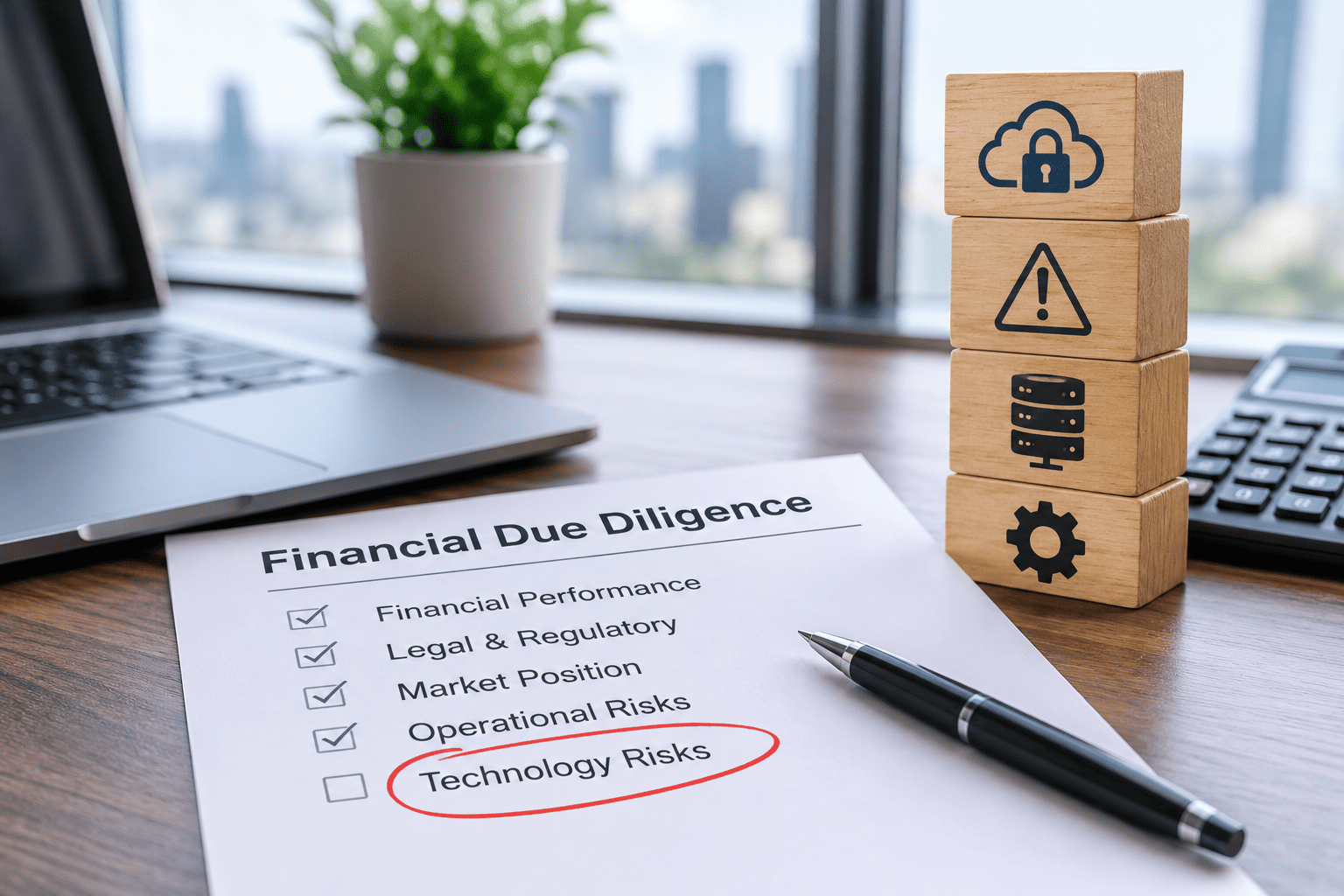
Not every technology issue represents a material investment risk.
The important distinction is whether a problem could affect growth, operating costs, business continuity, or the execution of the investment strategy.
Here are five areas worth examining before a transaction closes.
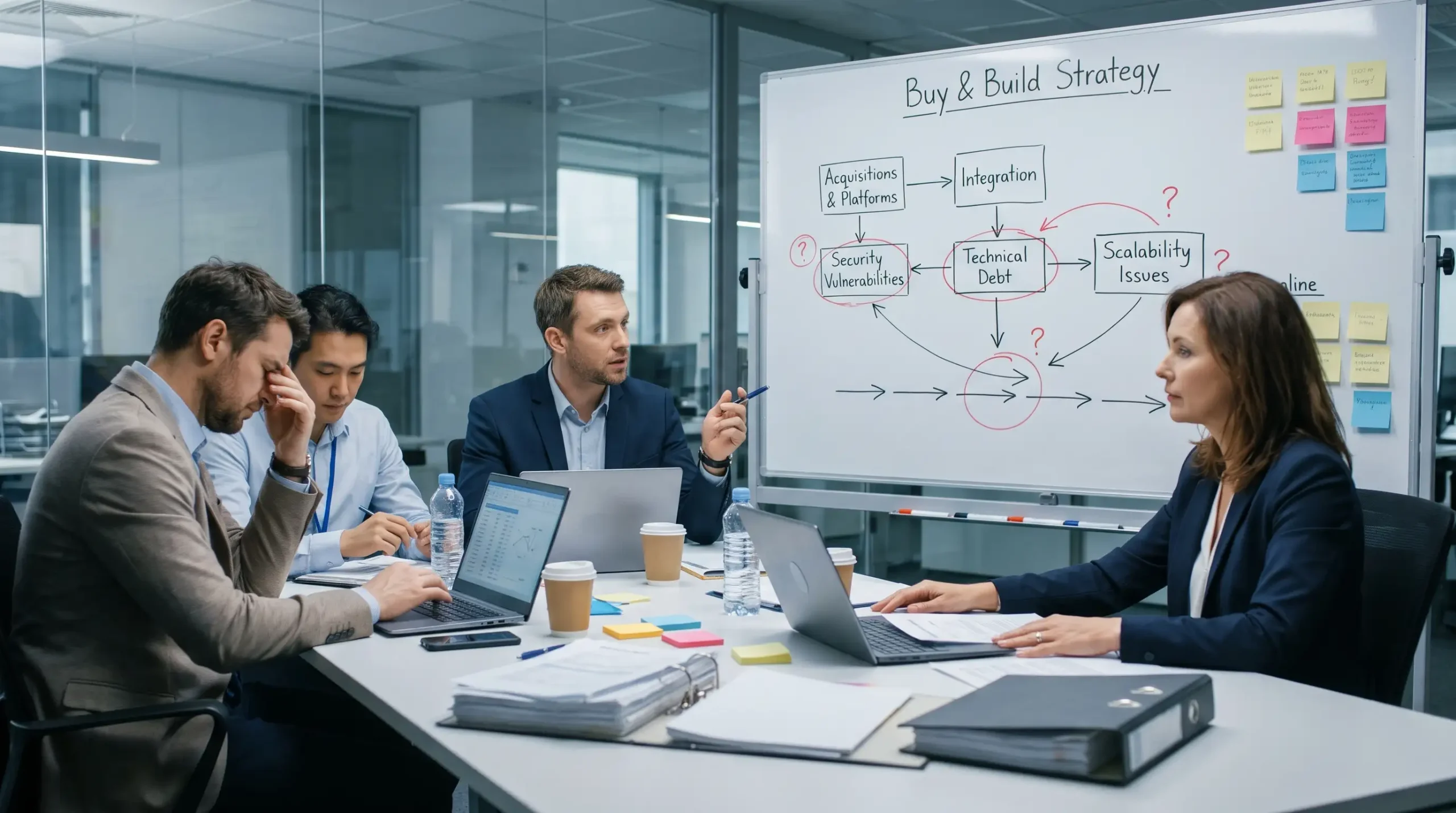
1. Technical Debt That Will Require More Investment Than Expected
A company may have deferred technology upgrades for years while continuing to operate profitably.
Legacy applications, unsupported software, aging infrastructure, and heavily customized systems can remain functional long after they become difficult or expensive to maintain.
That doesn’t automatically make them bad investments.
The risk emerges when the acquisition strategy requires capabilities those systems cannot support.
For example, a business planning to expand into new markets may discover that its existing systems cannot accommodate additional locations or transaction volumes without substantial changes.
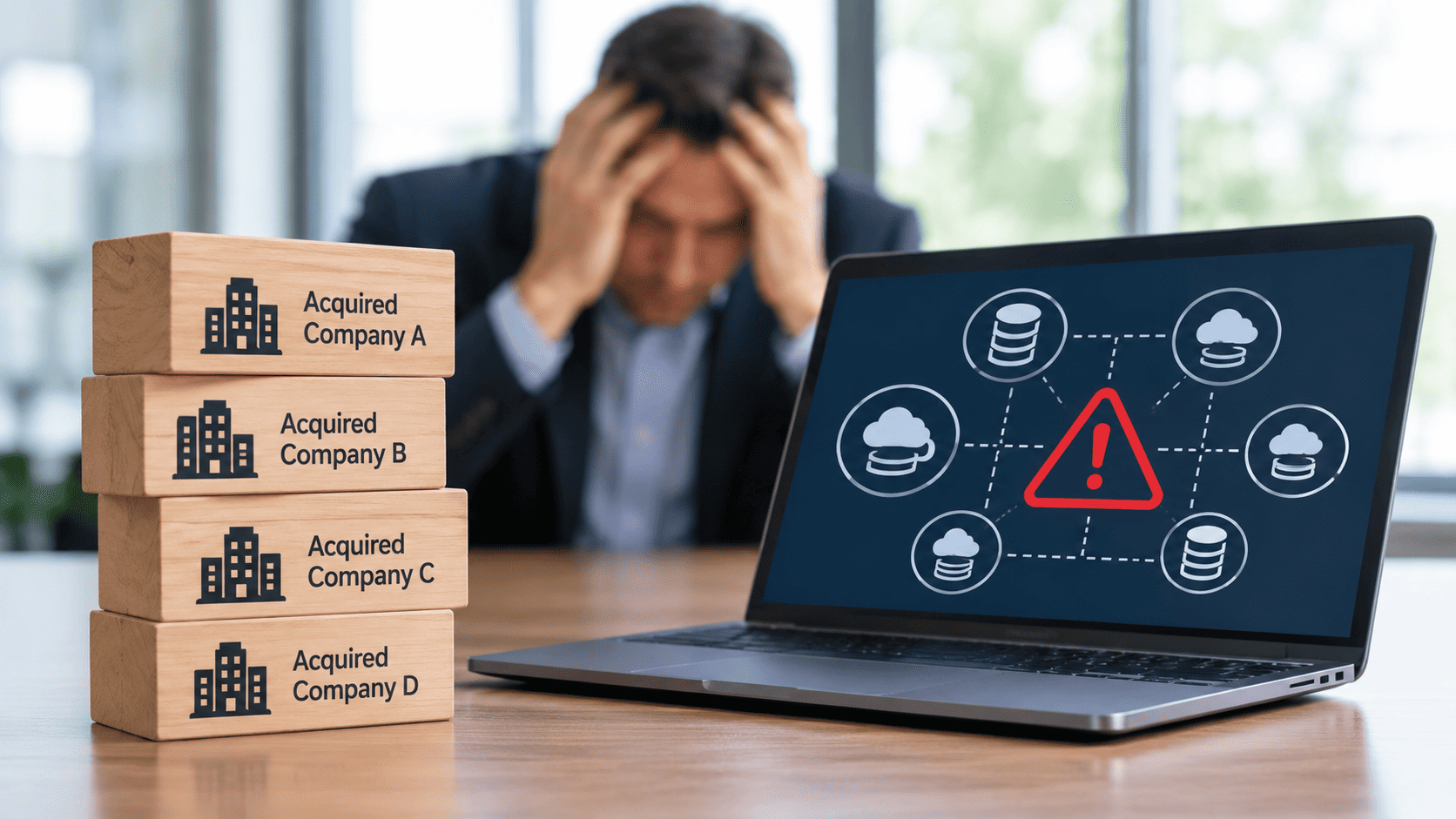
A platform planning additional acquisitions may find that its core applications are difficult to integrate with other businesses.
What to examine: Identify business-critical systems, their age and support status, major dependencies, and the estimated cost of changes required to support the growth plan.
The objective isn’t to eliminate every legacy system. It’s to understand which limitations could become expensive obstacles.
2. Cybersecurity Exposure That Isn’t Reflected in the Financial Model
Cybersecurity weaknesses can create financial and operational exposure that isn’t immediately apparent in historical results.
A target may lack consistent access controls, reliable backup and recovery processes, or adequate visibility into its systems.
It may also depend on third-party vendors without a clear understanding of the security responsibilities involved.
The absence of a major security incident doesn’t establish that the organization has adequate protection.
For an acquiring firm, the concern extends beyond the target itself.
An acquisition can introduce new vulnerabilities into an existing portfolio company’s environment, particularly when systems, networks, and data are connected after closing.
What to examine: Review security governance, identity and access management, critical vulnerabilities, incident response capabilities, backup and recovery arrangements, and relevant third-party dependencies.
The purpose is to identify material exposures and determine what remediation may require.
3. Infrastructure That Cannot Support the Growth Plan
A company’s technology infrastructure may be adequate for its current size but insufficient for the business the investor intends to build.
This becomes particularly important when the investment thesis depends on expansion, additional acquisitions, increased transaction volumes, or operational consolidation.
Systems that perform adequately today may encounter capacity, reliability, or integration limitations as the business grows.
Infrastructure limitations can also create unexpected costs if modernization becomes necessary sooner than anticipated.
What to examine: Assess the capacity, reliability, scalability, and support requirements of the systems most critical to the growth strategy.
The key question isn’t whether the infrastructure is modern.
It’s whether it can support the business outcomes assumed in the investment model.
4. Technology Knowledge Concentrated in Too Few People
Some businesses depend heavily on one or two individuals who understand how critical systems operate.
Those employees may have built custom applications, managed infrastructure for years, or developed undocumented processes that keep the business running.
From the outside, operations may appear stable.
But if critical knowledge is concentrated in a small number of people, employee departures or organizational changes can introduce significant operational risk.
The problem becomes more complicated when the acquisition strategy requires technology integration or major system changes.
What to examine: Determine who owns critical systems, where technical knowledge resides, how well important processes are documented, and whether the organization has sufficient leadership and support capacity.
A strong technology environment depends on more than its software and infrastructure.
It also depends on the people and processes required to operate it.
5. Technology Integration Costs That Haven’t Been Fully Considered
If the target will become part of an existing platform, the acquisition model may assume certain operational improvements.
Those improvements could depend on consolidating financial reporting, connecting customer systems, standardizing business processes, or eliminating redundant applications.
But achieving them may require more time, investment, and organizational effort than initially anticipated.
Some systems may be difficult to integrate. Others may require replacement. Data quality issues may delay reporting improvements.
When those requirements aren’t understood before closing, the platform can face unexpected costs and delays.
What to examine: Identify the major integration requirements, dependencies, likely costs, and realistic implementation timelines.
Technology integration should be evaluated against the investment thesis, not treated as an administrative task to address after the transaction.