
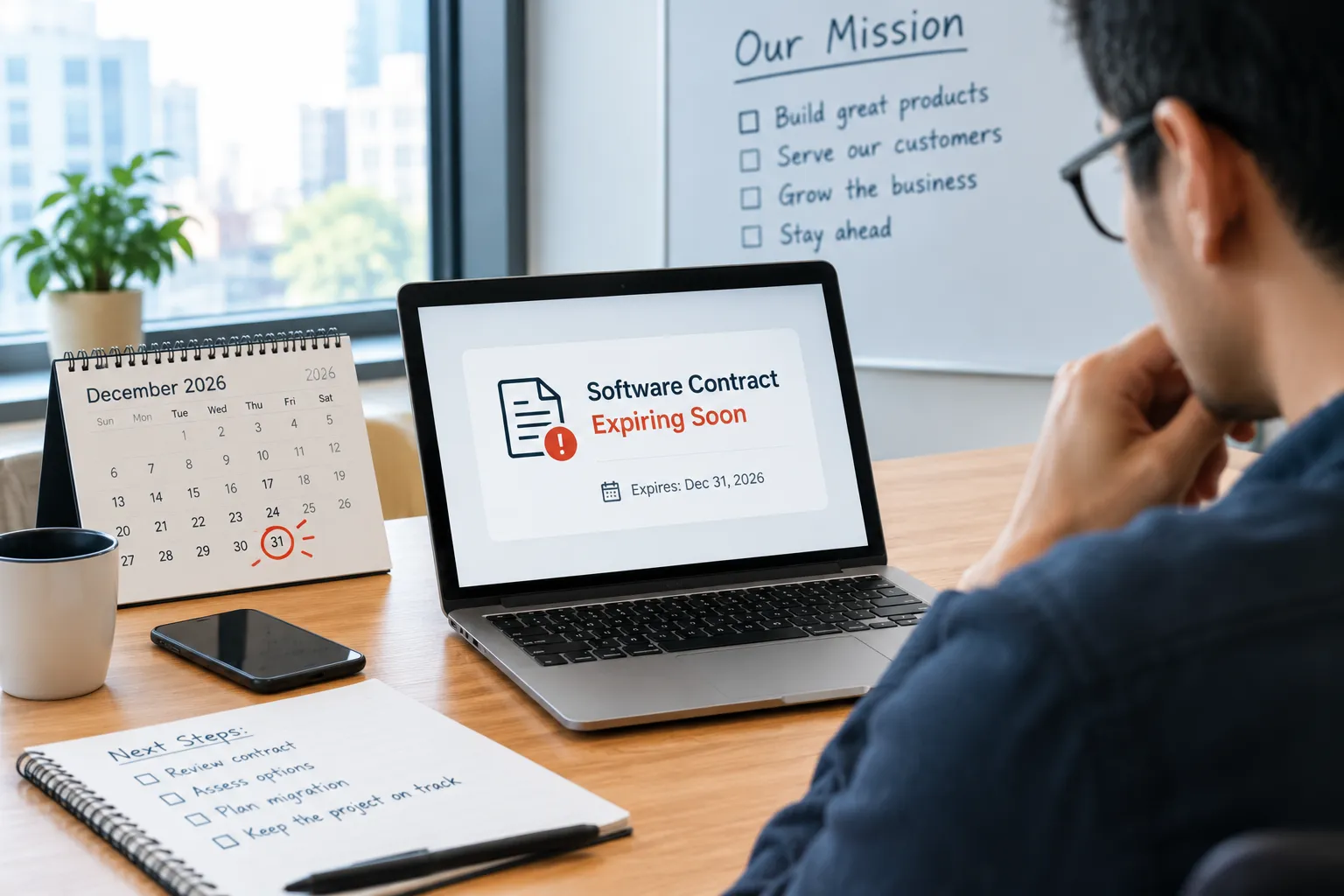
A software engineering recompete is more than a procurement milestone. It’s an opportunity to examine whether your current delivery model can support the mission ahead.
For federal defense organizations, software engineering contracts provide essential support for mission-critical applications, infrastructure, and ongoing development.
As contracts approach the end of their performance periods, program leaders face important decisions.
Should the organization maintain its current delivery approach? Are existing engineering practices meeting operational needs? What risks could emerge if support responsibilities change?
And perhaps most importantly: how can the program maintain mission continuity while preparing for its next phase of software delivery?
These questions deserve attention well before the next acquisition action.
Contract Expiration Creates a Decision Point
A contract approaching expiration does not automatically mean the government will conduct a new competition or change contractors.
The next acquisition action depends on the contract’s available options, ordering procedures, agency requirements, funding, and acquisition strategy.
Nevertheless, an upcoming acquisition decision can create an opportunity to evaluate the effectiveness of current software support.
For technical leaders, that evaluation should extend beyond contract administration.
It should consider whether the current engineering model is positioned to meet future mission requirements.
Important questions include:
- Are mission-critical applications receiving the maintenance and improvements they need?
- Are development and release processes meeting operational expectations?
- Is technical debt increasing the cost or complexity of delivery?
- Are engineering responsibilities, system dependencies, and documentation sufficiently understood?
- Could a future transition create operational or cybersecurity risks?
Without a clear understanding of these issues, an organization may carry existing constraints into its next period of performance.
The Hidden Risks of Software Engineering Transitions
Contract transitions can introduce challenges that are easy to underestimate.
In software environments, operational knowledge often extends beyond formal system documentation.
Engineers may understand undocumented dependencies, deployment procedures, integration limitations, and historical design decisions that are essential to keeping applications functioning.
When that knowledge is not adequately captured, changing support arrangements can create unnecessary disruption.
Four areas deserve particular attention.
1. Institutional Knowledge
Critical application knowledge may reside with individual engineers or specialized teams.
A transition-readiness assessment should identify knowledge dependencies and determine what documentation, training, and technical handover activities may be needed.
2. Application Architecture and Dependencies
Software applications rarely operate in isolation.
They depend on infrastructure, external services, data interfaces, security controls, and other systems.
An incomplete understanding of those relationships can complicate engineering changes and operational support.
3. Security and Authorization
Changes in contractors, personnel, tooling, or system responsibilities may require additional security coordination.
Program teams should evaluate applicable access requirements, authorization boundaries, cybersecurity responsibilities, and continuity of security evidence.
An existing Authority to Operate should not be assumed to transfer automatically or remain unaffected by material system changes.
4. Delivery Continuity
Ongoing development, defect resolution, operational support, and planned releases may need to continue during a transition.
Without clearly defined responsibilities and realistic transition milestones, the program may experience competing priorities and avoidable delays.
The objective is not to eliminate every transition risk.
It is to identify material risks early enough to manage them effectively.
Evaluate the Delivery Model, Not Just the Contract
When preparing for future software engineering support, organizations can benefit from examining how work is currently performed.
This includes assessing application condition, engineering capacity, delivery performance, documentation quality, and the effectiveness of existing processes.
The Government Accountability Office’s 2025 assessment of defense acquisition practices emphasized persistent delivery challenges and the importance of iterative development and testing approaches.
While that report focuses on broader defense acquisition, its findings provide useful context for evaluating software engineering delivery practices.
The key is to distinguish between problems that can be addressed through better management of an existing arrangement and those that may require changes in engineering practices, technical architecture, or future requirements.
A recompete should not be treated as proof that the incumbent is underperforming.
Instead, it provides a reason to examine whether the next delivery approach should preserve, improve, or change existing practices.
Five Questions to Ask Before the Next Acquisition Decision
Technical and program leaders can strengthen acquisition readiness by working through five practical questions.
1. What must continue without interruption?
Identify critical applications, operational support requirements, service dependencies, and activities that cannot tolerate significant disruption.
2. What engineering problems remain unresolved?
Document technical debt, recurring defects, delivery constraints, and modernization needs that affect mission performance.
3. What knowledge and technical assets must be retained?
Assess the availability of source code, documentation, configuration information, test assets, access procedures, and government rights to relevant deliverables.
4. What capabilities will future engineering support require?
Consider application architecture, cybersecurity, DevSecOps, integration expertise, modernization priorities, and relevant personnel or facility security requirements.
5. How will the government evaluate successful delivery?
Define measurable outcomes related to operational continuity, software quality, delivery performance, risk reduction, and mission requirements.
These questions can help technical stakeholders develop a clearer understanding of future needs and communicate them through authorized acquisition channels.
Engage Industry Through the Appropriate Channels
Federal acquisition procedures recognize the value of early communication with industry.
FAR 15.201 describes methods for exchanging information before proposals are received, including market research, industry meetings, requests for information, and draft solicitations. Such exchanges must comply with procurement integrity requirements and applicable acquisition procedures.
For program teams, appropriate market research can provide insight into available technical approaches, industry capabilities, and potential delivery considerations.
It can also help clarify requirements before a procurement decision is finalized.
However, technical discussions must respect the contracting officer’s authority and applicable competition safeguards. Vendors should not receive preferential access to procurement-sensitive information.
Effective engagement begins with a clear understanding of mission requirements and an appropriate process for discussing them.
Prepare the Mission, Not Just the Procurement
A successful software engineering transition is not defined solely by an award decision.
It is defined by whether the organization can maintain critical operations, preserve essential knowledge, and support future software delivery requirements.
That preparation begins with understanding the current environment.
STG Consulting helps leaders evaluate how technology decisions affect operational performance, cost, and risk.
Using the STG Strategic Technology Framework®, we connect technical priorities to organizational requirements and practical execution planning.
For organizations considering software modernization or future engineering support, that means identifying delivery constraints, evaluating modernization priorities, and developing a clearer understanding of the work required.
The goal is to make better-informed technology decisions while protecting the operations those technologies support.
Because the next contract period should do more than maintain the status quo.
It should support the mission ahead.
Your mission can’t wait. Neither should your software.