
STG

Start typing to search across every section of the site.

Loading…
Insights

What Is Strategic Technology Consulting? A Guide for Executives

October 1, 202612 min read
What Is Strategic Technology Consulting

Your technology budget went up again this year. Can anyone on your leadership team say what it bought?

And if you’re responsible for delivering against that budget, can you explain which priorities matter most - and which ones you’re allowed to stop?

That question is getting harder to avoid. Gartner forecasts that worldwide IT spending will reach $6.37 trillion in 2026, up 14.2% from 2025. Gartner’s own analyst cautions that the growth is uneven, with inflation, rising hardware costs and shifting priorities straining budgets even as they expand.

More money is going in. Proof of what it returns is not keeping pace.

Strategic technology consulting exists to close that gap.

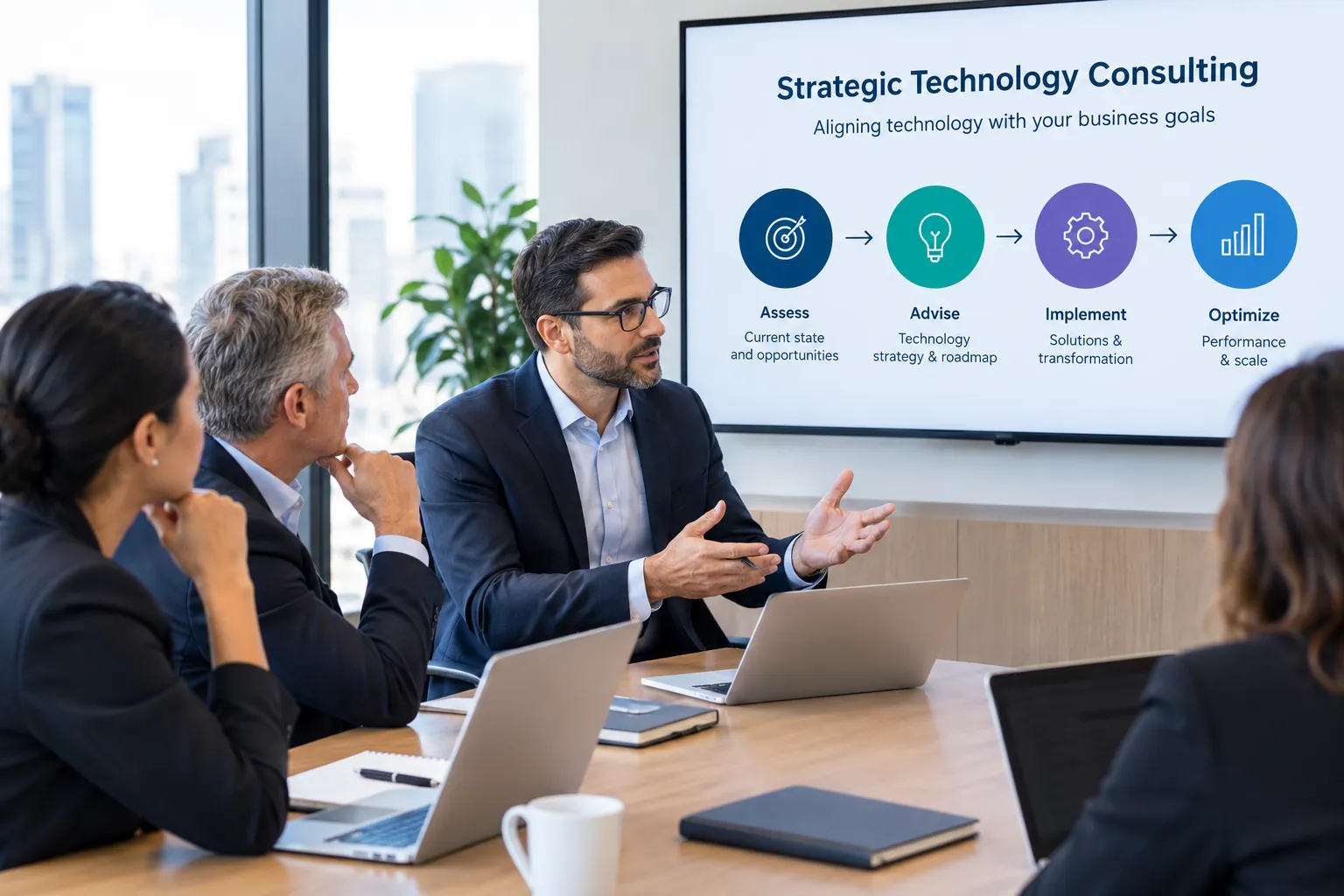
What is strategic technology consulting? Strategic technology consulting helps business and technology leaders align technology decisions with business priorities. It creates clarity around what to fund, what to fix, what to stop, who owns the outcome, and what should happen first - so teams can execute against a shared set of priorities instead of competing agendas.

This guide is for technology and operations leaders who are accountable for results but need stronger alignment around priorities - and for the executives responsible for the investment. It explains what strategic technology consulting actually does, how it differs from traditional IT consulting, what misalignment costs, and when outside perspective can help.


Why are companies turning to strategic technology consulting now?

Companies are turning to strategic technology consulting because technology spending is rising while many organizations still struggle to connect that investment to business results.

Technology investments often cross multiple functions: leadership sets the business priority, finance approves the investment, technology determines how to deliver it, and operating teams live with the result. When those groups aren’t aligned on the outcome, accountability gets fragmented.

Strategic technology consulting creates a shared decision framework so business and technology leaders can agree on priorities before teams are asked to execute them.

The research on this is unusually consistent.

48% vs 71%. Only 48% of digital initiatives meet or exceed their business outcome targets. Where the CIO and business leaders co-own delivery, that rises to 71%. Source: Gartner, 2025 CIO and Technology Executive Survey, 3,100+ CIOs and 1,100+ business executives, published October 2024.

The gap between those two numbers is not simply a matter of better software. Both groups can buy the same tools. The difference is how technology and business leadership work together around the outcome.

Other research points the same way. A BCG survey of more than 850 companies found that only 35% achieved their digital transformation objectives.

That’s the real case for strategic technology consulting.

Many technology problems are actually alignment problems. They show up as projects that finish without delivering the expected outcome, costs nobody can clearly attribute, competing priorities, repeated rework, and technology leaders constantly having to renegotiate what matters most.

The team may be executing exactly what it was asked to execute. The problem is that the organization never aligned on what success was supposed to look like.

What does a strategic technology consultant actually do?

A strategic technology consultant makes your current technology spending and priorities visible in business terms, then helps leadership decide what to fund, fix or stop.

The first deliverable is clarity: where money and effort are going, what the business expects in return, and where priorities or ownership are unclear. Recommendations and roadmaps come next.

In practice, the work moves through five decisions. The consultant shouldn’t make these decisions for you. The job is to give business and technology leaders enough clarity to make them together - and enough structure for the team to execute what was decided.

  1. See where the money actually goes. Split technology spend into what keeps the business running and what builds new capability. Most executive teams have never seen this split for their own company.
  2. Test each major investment against the business. Every significant system, project and contract gets the same question: which business priority does this serve, and how would we know whether it worked?
  3. Sort investments into fund, fix or stop. Some spending deserves more. Some needs to be restructured. Some should end, and ending it frees budget and capacity for the work that matters more.
  4. Build a roadmap leadership can understand and the team can execute. Create a ranked sequence of decisions with owners, dates and expected results, written in business language.
  5. Set the measures and the review rhythm. Establish a small number of measures, a baseline for each, and a quarterly review that shows whether the plan is working.

The same method applies whether the question is cloud spending, AI, aging systems, outsourcing or security.

The technology changes. The strategic questions remain largely the same:

What outcome are we trying to create? Why does this investment matter? Who owns it? How will we measure it? And what should we stop doing to make room for it?

How is strategic technology consulting different from IT consulting, managed services or a fractional CTO?

Strategic technology consulting answers what the business should do with technology and why. IT consulting and managed services answer how to build or run something already decided. A fractional CTO provides ongoing part-time technology leadership.

Many companies use more than one, but strategy should establish the direction so the other functions aren’t simply executing the wrong priorities more efficiently.

OptionThe question it answersTime horizonTypical deliverableBest fit when
Strategic technology consultingWhat should we fund, fix or stop, and why?1–3 yearsCurrent-state assessment, ranked roadmap, measuresPriorities are unclear, spending is rising, execution is fragmented, or leadership can’t tie technology work to business results
IT consultingHow do we deliver this specific project?Weeks to monthsA system selected, built or migratedThe decision is made and you need execution
Managed IT servicesHow do we keep systems running day to day?OngoingMonitoring, support, maintenanceOperations are the pain, not direction
Fractional CTOWho leads technology when we don’t have a full-time executive?Ongoing, part timeLeadership, oversight, team directionYou need a technology leader in the room every week

Be honest about which one you need.

If your strategy and priorities are clear but projects are consistently late, you may have a delivery problem rather than a strategy problem. If your systems run reliably but leadership and technology disagree about what should happen next, alignment and strategy may be the gap.

The line between strategic consulting and fractional technology leadership is often blurred. A fractional CTO can help carry a strategy forward after it is set; strategic consulting is often the step that creates the initial clarity and roadmap.

What does it cost to wait?

Waiting on technology alignment is not neutral.

Every quarter without clear priorities creates another opportunity for spending to drift, projects to expand, teams to rework decisions, and new initiatives to compete for the same people and budget.

The cost lands in three places leaders already track: operating cost, delivery and security risk, and growth the business planned for but did not get.

Cost: money that buys nothing

Flexera’s 2026 State of the Cloud report estimates that 29% of cloud infrastructure spend is wasted, the first increase in five years. The same survey of 753 organizations found that 17% exceeded their cloud budget in the past year.

Waste of that size does not necessarily show up as a line item labeled “waste.” It hides inside a bill that simply keeps growing.

Risk: projects that grow instead of finishing

A long-running study by McKinsey and the University of Oxford of more than 5,400 IT projects found that large ones run 45% over budget on average and deliver 56% less value than predicted.

Every additional year on the schedule added about 15% to cost overruns, and 17% of projects went badly enough to threaten the company itself.

The data dates from 2012, and it remains a widely cited benchmark for the cost and risk of large technology programs.

Delay is not always a pause. It can become a cost multiplier.

That’s why technology risk belongs on the executive agenda, not only the IT one.

Growth: AI spending without a return

IBM’s 2025 CEO Study of 2,000 chief executives found that only 25% of AI initiatives had delivered their expected return, and just 16% had scaled across the enterprise.

The challenge isn’t simply adopting AI. It’s deciding where AI can create measurable value, which use cases deserve investment, and what evidence will determine whether they continue.

What two more quarters look like

Picture the next board meeting if nothing changes.

The cloud bill is higher, and still nobody can say which product or customer drives it. The largest project has slipped another quarter, and its budget has quietly grown with it. Three AI pilots are running, each with a champion and none with a measure.

Meanwhile, your technology team is balancing the roadmap against another round of urgent requests, each backed by a different stakeholder.

None of this is a crisis yet.

That’s exactly why it keeps compounding.

How do you know if your company needs outside technology strategy help?

Your company may benefit from strategic technology consulting when leadership cannot clearly answer basic questions about where technology money and effort are going, which priorities matter most, and what results the business expects.

The questions below are best answered by business, finance and technology leadership together.

The differences between their answers may tell you as much as the answers themselves.

  • What share of the technology budget keeps current systems running, and what share builds something new?
  • Can finance attribute cloud spending to a product, a customer or a business unit?
  • Which technology projects launched in the last 12 months delivered their original business case?
  • Who decides which AI initiatives get funded, and what measure will prove they worked?
  • If your most senior technology person left tomorrow, is there a written roadmap leadership has seen and agreed to?
  • If you asked your CEO, CFO and technology leader to name the top three technology priorities, would they give you the same answer?

When several answers are “no,” “not sure,” or simply different depending on who you ask, the issue is rarely effort or talent.

More often, the organization lacks a shared framework for connecting technology decisions to business results.

What should a technology strategy engagement deliver?

A technology strategy engagement should deliver more than a list of technology recommendations.

It should create visibility, alignment, decisions and a path to execution.

Concretely, expect:

  • A current-state picture in business language. Spending, systems, contracts and teams mapped to what they do for the business. Leadership should not need an architecture diagram to understand it.
  • Shared priorities and decision rights. Agreement on what matters most, who makes which decisions, and what the technology team can deprioritize when new requests appear.
  • A ranked decision list. What to fund, what to fix and what to stop, in priority order, with the reasoning visible.
  • A roadmap with owners. Work sequenced over 12 to 36 months, with named owners and expected results for each step.
  • Measures and a review rhythm. A small number of measures with baselines, reviewed quarterly so the plan can be corrected before it drifts.

If an engagement ends with a long list of recommendations but nobody knows what happens first, who owns it or what should stop, it has not solved the strategy problem.

How do you choose a technology strategy partner?

Choose a technology strategy partner for independence, business-first thinking and plain-language deliverables, not for the length of its service catalog.

The right partner starts from your goals, execution challenges and numbers. It should have no financial reason to favor a particular solution and should remain focused on outcomes rather than hours billed.

Five criteria are worth testing in the first conversation:

  1. Independence. Ask whether the firm resells software or holds vendor partnerships. Resale incentives can shape recommendations, whether anyone intends them to or not.
  2. Starts from business goals. A good consultant asks about business goals, execution challenges, growth targets, margins and risk before recommending changes to your technology stack.
  3. Deliverables leadership can understand. Ask to see an example roadmap. If it needs a translator, it will be difficult to use for alignment and decision-making.
  4. Accountable to outcomes. Ask how the firm measures its own success on an engagement and how it determines whether its recommendations are producing the expected result.
  5. Neutral on sourcing. Onshore, nearshore and offshore teams each have a place. The goal is the right balance of alignment, capability, cost and delivery - not simply the lowest hourly rate.

One warning sign is worth naming: a consultant who recommends a platform before understanding your business goals and current state may be selling a solution rather than helping you make a decision.

How STG Consulting helps business and technology leaders get clarity

Most leadership teams don’t need another list of technology recommendations.

They need clarity about what matters, agreement on what happens next, and confidence that the plan can actually be executed.

That’s where STG Consulting starts.

STG helps business and technology leaders identify where priorities, spending and execution are out of alignment, then turn that clarity into a practical roadmap.

Every engagement starts with business goals, not the technology stack. STG holds no vendor partnerships, so its advisors carry no financial incentive to recommend one platform or vendor over another.

The work is built on the STG Strategic Technology Framework®, developed with a council of chief technology officers. It maps nine dimensions of technology strategy and execution.

The Business Technology Assessment applies that framework to your organization and includes a Risk and Readiness Review, scored by a panel drawn from STG’s CTO Council and peer-reviewed before it reaches you.

The goal isn’t simply to identify what’s wrong. It’s to determine what matters most, what decisions need to be made, and what should happen next.

From there, STG can stay on to support strategy and execution, provide ongoing technology leadership, or hand a clear roadmap to your internal team.

Executive teams at organizations including CR England, Nu Skin and Davis County have worked with STG.

Strategic technology consulting isn’t about giving your technology team more to do. It’s about giving them greater clarity about what matters - and giving leadership greater confidence that technology investment is moving the business forward.

See where priorities, spending and execution are out of alignment

Not sure whether the problem is your technology - or the alignment around it?

STG can help you see where priorities, spending and execution are disconnected, which decisions matter most, and what needs to happen next.

Show me where we’re misaligned →

Start with the Business Technology Assessment.

Not ready for an assessment? Get 30 minutes of executive perspective.

Frequently asked questions

What is the difference between strategic technology consulting and IT consulting?

Strategic technology consulting helps business and technology leaders decide what to fund, fix or stop - and why - based on business priorities and expected outcomes.

IT consulting delivers a specific project once that direction is established, such as selecting, building or migrating a system.

Strategy establishes what matters and why. IT consulting helps execute a defined decision.

Is a fractional CTO the same as a strategic technology consultant?

No, though the roles overlap.

A fractional CTO is an ongoing, part-time technology executive who helps lead teams, make decisions and oversee delivery week to week.

A strategic technology consultant typically runs a defined engagement that assesses the current state, aligns leadership around priorities and produces a roadmap.

Some companies use strategic consulting to establish direction and a fractional CTO to help carry it forward.

How much does strategic technology consulting cost?

The cost of strategic technology consulting depends on company size, the number of systems and business units in scope, and whether the engagement is a one-time assessment or ongoing advisory work.

The more useful comparison is often the cost of the problems the strategy is intended to address: unnecessary spending, rework, project overruns, delayed decisions and initiatives that consume resources without producing the expected outcome.

What size of company benefits most from strategic technology consulting?

Mid-market and enterprise companies can benefit significantly, especially when technology spending has become material, multiple departments influence technology decisions, or the organization lacks full-time strategic technology leadership.

The need is often most visible during fast growth, after an acquisition, before a major platform or AI investment, or when technology spending and execution demands are increasing faster than leadership’s ability to prioritize them.

Smaller firms with simple systems may need strong IT support more than a formal technology strategy.

How do you measure whether technology spending is driving growth?

Start by tying each major technology investment to a business outcome and a measurable indicator, such as revenue per customer, cost per transaction, time to launch, employee productivity, risk reduction or another measure relevant to the investment.

Record the baseline before the investment, then review progress on a regular cadence with business and technology leadership.

If an investment cannot be connected to a meaningful business outcome, that is itself an important finding.

See exactly where your technology stands

Five minutes today can reshape your next budget cycle. Get your technology score, benchmarked against what high-performing organizations actually do.

Share this article